
I'mSam Muthu
Anthropic Claude Certified Architect

15+ years building enterprise systems · Founding AI Engineer & Architect, Zen Algorithms
Open to Principal, Staff and Senior AI Engineer and AI Architect roles.
🏅 Certified across 12 domains
Foundations: agent orchestration, Claude Code, structured output, tools and MCP, context and reliability. Professional: solution design, models and context, integration, evals and optimization, governance and risk, stakeholders, developer productivity. Verify on Credly · my free study guide: claude.sammuthu.com.
🏗️ Built in production
15+ years of enterprise systems, including five at Wells Fargo on an identity platform for 30M+ customers under SOX and PCI-DSS, and hands-on with enterprise GenAI since 2023. Today I design, build and deploy agent systems through Zen Algorithms, and my side projects keep running in production: CosmicKeys, WatchAlgo, Mnemos (open-source local RAG) and 15 CosmicFlow Archives.
What I deliver
Workflow automation
Prompt-chained pipelines for fixed, auditable processes — the right tool when the steps are known.
Multi-agent systems
An orchestrator coordinating specialist subagents, with human approval and escalation where it matters.
MCP integrations
Servers and clients in Python and Java that connect agents to databases, APIs and internal tools, with scoped permissions.
RAG and knowledge
PostgreSQL + pgvector, hybrid search (BM25 + vector) and re-ranking; Vertex AI Vector Search for managed scale.
Model routing and cost
One adapter layer across Claude, OpenAI, Gemini and Grok — portable to Bedrock, Vertex AI and Azure OpenAI.
Evals and guardrails
Golden-set tests and regression gates before any prompt or model change ships; policy enforced in code.
The Intellectual Lineage Behind My Side Projects
Three of my shipped projects share one philosophical backbone — borrowed from a thinker I respect deeply.
“It isn't 10,000 hours that creates outliers, it's 10,000 iterations.”
— Naval Ravikant
Naval Ravikant is the biggest influence on how I think about deliberate practice and building your own tools. His 10,000-iterations theory became the backbone for three projects (Segment Loop Master, CosmicKeys, WatchAlgo); his broader thinking on personal sovereignty — own your stack, keep your knowledge yours — shaped a fourth (Mnemos, my open-source local-first personal RAG).
Two threads from one thinker, four projects: three iterate toward mastery, one keeps your knowledge yours.
A small tap from the source
The actual sequence — precision matters when the person being talked about might one day read the page. In October 2025, after building Segment Loop Master and publishing its implementation page on this site, I replied to @naval's 10,000-iterations thread with the link — “your 10-word tweet became my personal product requirement.” He liked that reply (presumably after visiting the page). That single tap meaningfully shifted my confidence about the direction. Four months later, with CosmicKeys live in 7 languages and 9 regions, I posted a follow-up to the same thread about it. He didn't engage with that one — Naval doesn't repeat-engage like that, and I wasn't expecting him to. WatchAlgo and Mnemos came after, each on its own page.

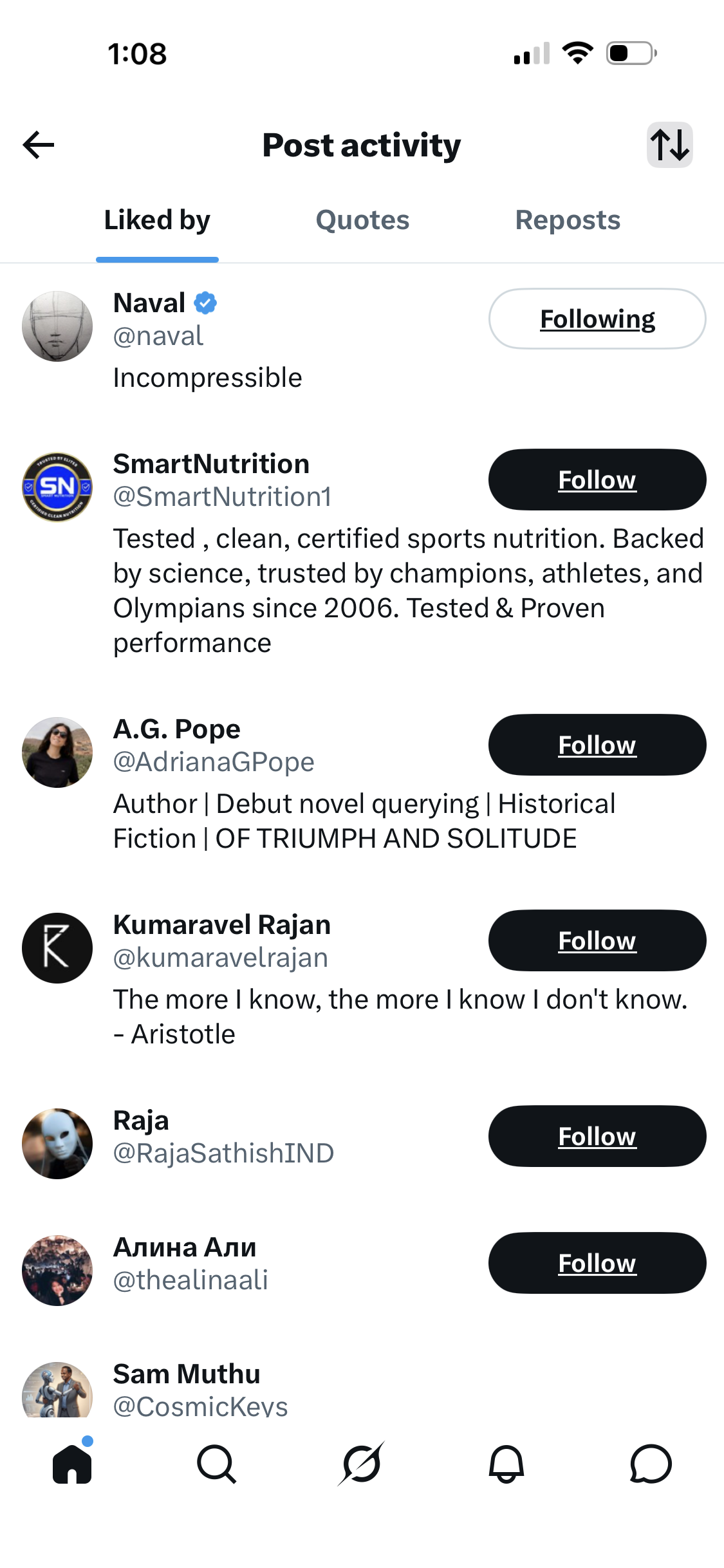
Naval doesn't liberally hand out likes. When he engages with a builder, it's signal, not noise.
Small tap, big meaning when it's from the source.
AI-Native Engineering: A Living Index
Architecture Deep Dives
Most engineers use AI as autocomplete. I architect production agentic systems — multi-agent orchestration, RAG pipelines, model routing, and automated quality gates.
Developer General Intelligence
DGI is here — AGI’s practical cousin for engineering. I embedded a multi-model LLM council directly into the architecture view: interrogate any component live, and the spec crystallizes underneath. Architecture as the Product.
This Is Not a Chatbot
A real agent, built end to end — requirement to evals — with every decision on the record. The model decides; a deterministic harness executes. The injection defenses, the money gate, a golden set with a negative control, and screenshots of the actual IDE and build process.
Local LLM Field Notes
First-hand friction log evaluating open-weight models on an M4 Max / 128 GB laptop — GLM-4.5-Air in MLX-4bit, the memory math that rules out the 750B models, Ollama vs LM Studio, and the honest verdict.
AI Factory
Production agentic framework with multi-agent orchestration, RAG pipelines, and Report Cards.
CosmicKeys
Typing platform with voice narration, 8 languages × 10 keyboard regions, 34 layouts, multi-region anycast routing.
WatchAlgo
AI content factory: 3,247 problems × 3 languages × 3 flavors with automated validation.
CosmicFlow Archives
Independent, non-commercial YouTube archives — every full session on its own subdomain, six languages, refreshed nightly. One template; a new archive is a persona file, not a codebase.
From the ask to the release
Coding agents shortened the build; they did not shorten the impact analysis. One business ask followed to production twice — the traditional path, counted, and the path where one owner drafts the brief, impact map, API contract, mock and stories before the first meeting.
QuoteCraft — Agentic Underwriting
A property-insurance POC — built on years of group-benefits platform experience — showcasing agentic systems around the full pipeline: auto quote generation, configuration-driven products, and an underwriting console where AI drafts and a human owns the decision.
Claude Architect Field Guide
The complete study guide for Anthropic's Claude Certified Architect exams — all 5 domains, the agent loop traced with real payloads, 50+ clickable glossary cards, deployment architectures, practice questions, and a capstone build. Free for everyone.
Agentic Scaling — how consumer AI serves a billion people
A diagram-led, first-principles explainer of how frontier labs run personal AI at scale — the context pack, memory namespaces, the stateless fleet and its control plane, token economics, quality and trust — and the one-to-one mapping onto enterprise systems.
Cosmic Managed AI Service
The managed AI service layer for the post-hyperscaler era — vendor-agnostic, infra-first, BYO-everything. 5 pillars + control plane + 4 deployment envelopes.
Mnemos
Personal RAG, 100% local by default. Drop a folder, ask cited questions from your laptop — or from your phone via a private Telegram bot. MIT-licensed, active development (v0.11).
BurnWall
Founder runway dashboard: bank statements in → sliding-window burn rate, runway, and a decision deadline out. Built March 2026, in daily personal use since.
AI Foundations
How I think about LLMs, agents, and production AI — from first principles to shipped systems.
Enterprise RAG Anatomy
Full production RAG pipeline — architectural + sequence diagrams, 15-step walkthrough, naive vs agentic.
Agent Frameworks
LangChain, CrewAI, AutoGen, LlamaIndex, Pydantic AI — honest comparison with code and when to pick each.
No-Code Agent Builder
Flowise — the open-source visual canvas for LLM apps and agents (acquired by Workday). Hands-on series: install, build, inspect the database, and what I'd evolve.
Microsoft AI
Azure AI Foundry, Azure OpenAI, GitHub Copilot, Responsible AI Toolbox. The enterprise stack for organizations anchored on Entra ID, M365, and Azure regional compliance.
Google AI · Vertex AI · Gemini
Vertex AI (Model Garden, Endpoints, Pipelines, Vector Search, Agent Builder) plus Gemini's multimodal 1M+ token context. The GCP-native managed stack.
OpenAI
GPT-4o, GPT-5, o-series reasoning, the Responses API, Realtime API, Codex CLI, Swarm agents. The pace-setter on frontier capability.
Anthropic · Claude · MCP
Claude (Opus, Sonnet, Haiku), Claude Code, MCP, Computer Use, Constitutional AI. The most opinionated take on AI-native software engineering.
MCP Server Pattern
Got a REST API? Here's how to wrap it as an MCP server so AI agents (Claude Desktop, Cursor) consume it natively — and how to build a CLI that uses the same server. Subscription-status example, runnable code.
Model-Agnostic Architecture
Your AI vendor is a dependency, not a destiny. Six layers — provider gateway, model-selection decision matrix, guardrails, multi-tenant isolation, and encryption in transit (mTLS) and at rest.
Observability & Evals
Langfuse, LangSmith, Braintrust, RAGAS, DeepEval, LlamaGuard — how the industry is adopting LLM observability, evaluation, and safety tooling.
Platform Anatomy
Control plane + data plane + guardrails + observability. Vendor-neutral architectural reference with Microsoft, AWS, and custom-stack mappings.
AI Underwriting Agent
Browser-native wildfire property underwriting demo — k-NN precedent retrieval, geographic concentration guardrail, novel-case routing, and broker trust signals. Zero backend.
What I Learned by BuildingAn Engineer's Journey Through the AI Transformation
After years of building enterprise systems — from Wells Fargo's identity platform to HP's webOS ecosystem to Ericsson's global streaming infrastructure — I realized something: the craft of software engineering has fundamentally changed.
The skills that matter now aren't memorizing APIs or writing boilerplate. They're architectural intuition, problem decomposition, and knowing how to orchestrate AI models to produce reliable, production-quality output. I've been proving this since 2025 — not by reading papers, but by shipping live side projects. Every project below was built by one engineer and an LLM Council of AI collaborators.
The Onyx RAG Platform below was one of the first examples — a retrieval-augmented generation prototype with multi-tenant architecture, custom PDF connectors, and semantic search, built in weeks instead of quarters. Since then the same approach has produced production RAG on pgvector with hybrid search and re-ranking, and Mnemos, my open-source local RAG.
Segment Loop Master10,000 Iterations to Mastery
Inspired by @naval's wisdom "It's actually 10,000 iterations to mastery, not 10,000 hours. And it's not even 10,000 but some unknown number—it's about the number of iterations that drives the learning curve."
Iteration is NOT repetition Repetition is doing the same thing over and over. Iteration is modifying it with a learning and then doing another version—that's error correction. Get 10,000 error corrections in anything, you'll be an expert
Interestingly, Hindu traditions understood this with mantras repeated 108 or 1,008 times—but perhaps what was lost in translation was the iteration aspect. It wasn't just repetition, but conscious refinement with each cycle.
I built this video segment looper for deliberate practice—to master concepts through conscious iteration, not mindless repetition. While I can't release it publicly due to content rights, if you're interested in the concept, reach out. Together we could create a platform where people upload their own content for iterative learning.
Technical Mastery Hub17 Learning Paths • 5 Domains • Infinite Possibilities
From ZenAlgo to Cloud Architecture. From AI Development to DevOps Excellence.
I'm building the technical learning platform I wish existed—where complex concepts become crystal clear through interactive visualizations, real-world projects, and battle-tested patterns.
Master the art of scaling from 1K to 1 Billion users with proven DevOps strategies
Now live: deep dives on the MCP server pattern, enterprise RAG, observability and evals, and the Claude Architect Field Guide — plus the Onyx RAG Prototype.
The Truth About AI Agents, NowAgents are no longer the experiment. Engineering them well is the job.
📈 Mainstream and stable
Agents moved from demos to production. Models follow instructions and call tools reliably, and harnesses like the Claude Agent SDK, LangGraph and MCP made the plumbing standard. Most teams are shipping one now, not debating one.
⚙️ Most agents are automation
In what I see, 80% or more of production agents automate a known workflow: intake, triage, extraction, routing, drafting. Fully open-ended autonomy is the minority, and that is usually the right call.
🧭 Pick the simplest pattern
A prompt chain when the steps are known; a tool-calling loop when they are not; an orchestrator with specialist subagents only when the work truly branches. Every extra agent is a cost, not a feature.
✅ Reliability is engineered
The model is rarely the bottleneck now. Golden-set evals, regression gates, schema-validated outputs, human approval on irreversible actions and policy enforced in code are what separate a dependable agent from a demo.
🔌 Integration is standardised
MCP turned N×M custom integrations into N+M. Scoped tools, structured errors and least-privilege permissions are the new security perimeter.
🎓 The discipline is certifiable
Anthropic's Claude Certified Architect exams now cover agentic architecture, Claude Code, prompting and structured output, tools and MCP, and context and reliability — knowledge that was tribal a year ago. I wrote a free field guide for it →
What still holds from day one
The spec bounds the output — agree the architecture and acceptance criteria before any code is generated. Context compounds — an agent that records its decisions and dead ends is far more useful in month two than on day one. How I build a real agent →
The question is no longer whether agents work. It's whether yours is engineered to keep working.
Hobby ProjectsThings I build because I want them to exist.
It started with one page for Sai Pallavi: her films, interviews and ideas in one place, in six languages. Then the same wish kept coming back for other people I learn from: where is everything they said, in order, without the clips?
So the page became a template, and the template became a family: podcast hosts, teachers, a spiritual guide, and homeschool lessons in course order. Each archive is independent and unofficial, plays on YouTube where the video was published, and refreshes itself every night.
The archives home
One directory for every archive: podcasts, learning, science, spiritual and cinema. Search it, open any archive, or request the next one and vote on what gets built.
Two Ways to Work TogetherJoin your team, or build with it
Banking-grade reliability discipline plus production agentic AI: as your next AI architect, or as your consultant
For Employers
Open to Principal, Staff and Senior AI Engineer and AI Architect roles — at enterprises or early-stage startups. Bay Area · US Citizen.
View Experience PortfolioFor Teams
Architecture review, proof of concept, or build and deploy — agent systems, MCP, RAG and evals, through Zen Algorithms.
Visit zenalgo.aiWant more details? Ask ChatGPT about me. It knows a few things 😉