Microsoft AI
Azure AI Foundry, Azure OpenAI, GitHub Copilot, Responsible AI Toolbox — the enterprise AI stack optimized for organizations already invested in Entra ID, M365, GitHub, and Azure regional compliance.
The Microsoft + OpenAI Story
Does Microsoft have its own frontier model?
No — and that's not the goal. For frontier-class capability (GPT-5 / Claude Opus / Gemini 2 tier), Microsoft is a distribution partner of OpenAI, not a competitor. Microsoft Research has the Phi family (small models, 1B–14B parameters) — impressive for their size, useful for cost-sensitive workloads, but explicitly not competing at the frontier.
The frontier-vs-edge split is deliberate: Microsoft built its AI strategy around being the enterprise distribution layer for OpenAI's frontier models, plus its own efficient small models (Phi) for embedded and edge workloads. That's a different bet than Google (which builds its own frontier models, Gemini) or AWS (which hosts everyone, models from Anthropic / Meta / Stability / Mistral via Bedrock).
Isn't Copilot Microsoft's AI?
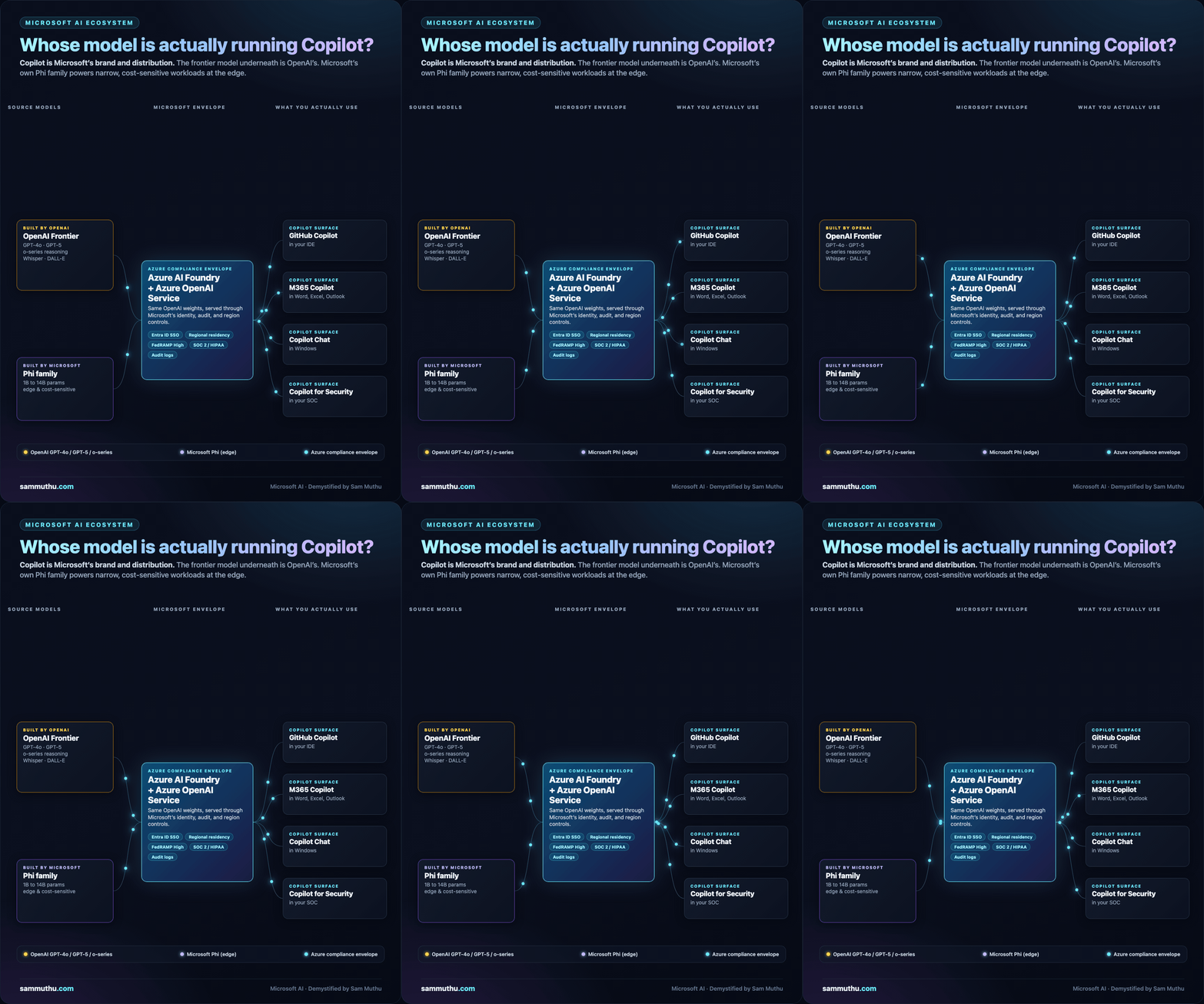
Copilot is Microsoft's brand and distribution, not Microsoft's model. Almost every Copilot you touch is running OpenAI weights underneath. GitHub Copilot in your IDE, M365 Copilot in Word and Excel, Copilot Chat in Windows, Copilot for Security in your SOC — same Copilot name, same Microsoft compliance envelope (Entra ID, audit logs, regional residency), but the model doing the heavy lifting is GPT-4o, GPT-5, or an o-series reasoning model from OpenAI. Microsoft's own Phi models occasionally serve narrow, cost-sensitive Copilot features, but the headline experience is GPT.
The distinction matters when you're making architecture decisions. “Should we use Microsoft or OpenAI?” is the wrong framing for most enterprise choices, because the real answer is usually both at once: OpenAI's model, behind Microsoft's compliance wrapper, in your chosen Azure region. The two questions that actually matter are which OpenAI model you're hitting, and through which Azure region's compliance posture.
How the partnership actually works
- 2019:Microsoft and OpenAI sign an exclusive cloud partnership. Microsoft invests $1B. Azure becomes OpenAI's exclusive cloud provider for compute.
- 2023:After ChatGPT's success, Microsoft invests $10B more. Total commitment now $13B+. OpenAI's frontier models become exclusively available to cloud customers via Azure OpenAI Service — same models, Microsoft compliance regime.
- 2024:GitHub Copilot migrates to GPT-4o; M365 Copilot launches with OpenAI models under the hood; Azure AI Studio rebrands to Azure AI Foundry as the unified developer surface.
- 2026:The arrangement holds. GPT-5, o-series reasoning models, Whisper, DALL-E — all available exclusively to cloud customers via Azure OpenAI Service. Direct OpenAI API is for individuals and startups; enterprises that need compliance go through Azure.
Where each model actually comes from
- • GPT-4o, GPT-5, o-series reasoning
- • Whisper (speech-to-text)
- • DALL-E (image generation)
- • text-embedding-3
Sold to enterprises via Azure OpenAI Service
- • Phi-3, Phi-4 (small models)
- • Orca series (research, edge)
- • Florence (vision)
- • MAI (Microsoft AI internal, not yet shipped)
Used for cost-sensitive / edge workloads
The strategic logic: Microsoft brings Fortune 500 enterprise distribution (M365, Azure compliance, Entra ID, regional residency); OpenAI brings frontier models. Each company's strength compounds the other's. The result: Azure OpenAI Service is how nearly every regulated enterprise consumes OpenAI.
ZoomedIn Walkthrough — A Skill-Matching App on Azure AI
The fastest way to demystify Azure AI is to walk a real application from before-AI to after-AI. Same example as the Vertex AI page for direct comparison: ZoomedIn.us — a (hypothetical, in-development) skill-matching service. LinkedIn-shaped, but agent-first. We'll show how it's built, deployed, and made vendor-agnostic on Microsoft's stack.
ZoomedIn before AI — a normal Azure web app
Pre-AI, ZoomedIn is a standard 3-tier app on Azure:
- 🖥️ Frontend: Next.js 15 on Azure Container Apps (same container-based scale-to-zero you'd get from Cloud Run)
- 🐍 Backend: FastAPI on Azure Container Apps — REST endpoints for users / jobs / applications
- 🗄️ Database: Azure SQL Database (or Cosmos DB if you prefer document model)
- 📁 File storage: Azure Blob Storage for resumes
- 🔐 Identity: Entra ID for user sign-in (and for agent OAuth tokens later)
Matching is deterministic SQL — exact-string match on a normalized skill table. Works on day one. Breaks on day 30 when users write “Python wizard” instead of “Python”. Same problem as on GCP — deterministic matching has no concept of meaning.
Add semantic matching via Azure AI Foundry
Replace exact-string-match with semantic similarity. Embed each skill (and user profile, and role) into a 1536-dimensional vector using Azure OpenAI's text-embedding-3-large. Store vectors in Azure AI Search (hybrid vector + keyword + semantic ranker out of the box). Use Azure AI Foundry agents to orchestrate matching + explanation.
# pip install azure-ai-projects azure-identity openai
from azure.identity import DefaultAzureCredential
from openai import AzureOpenAI

# Auth via Entra ID - no API keys in code, ever
credential = DefaultAzureCredential()
client = AzureOpenAI(
    azure_endpoint="https://zoomedin-aoai.openai.azure.com/",
    api_version="2024-10-21",
    azure_ad_token_provider=lambda: credential.get_token(
        "https://cognitiveservices.azure.com/.default"
    ).token,
)

def embed(text: str) -> list[float]:
    """1536-dim vector via Azure OpenAI. ~40ms."""
    resp = client.embeddings.create(
        model="text-embedding-3-large",  # your AOAI deployment name
        input=text,
    )
    return resp.data[0].embedding

# Then index via Azure AI Search (hybrid retrieval)
profile_vec = embed("Python wizard, 8 years, ML pipelines, AWS")Two new pieces enter the Azure architecture:
- 🔍 Azure AI Search — managed hybrid retrieval (vector + BM25 + semantic ranker). One service handles what would otherwise be pgvector + Elasticsearch + a re-ranking model. The retrieval equivalent of Vertex Vector Search, with stronger hybrid out-of-the-box.
- 🧠 Azure OpenAI Service (GPT-4o / GPT-5) for fit explanations. Same OpenAI weights as the public API, but in your Azure region, under your Entra ID identity, audited to your Azure Monitor — the compliance envelope is the entire reason enterprises pay the Azure premium over direct OpenAI.
Vendor-locked vs vendor-agnostic — Azure-flavored
Azure's vendor-agnostic story is structurally similar to Vertex's: the same orchestration layer (Foundry) lets you call OpenAI models OR open-weight / partner models via the Model Catalog. The discipline is in how YOU write the code.
🔒 Mode A — Locked to Azure OpenAI
Direct, fast to ship. But if regulator says “you must support Llama for sovereign deployment”, every call site changes.
from openai import AzureOpenAI

client = AzureOpenAI(
    azure_endpoint=AOAI_URL,
    api_version="2024-10-21",
    azure_ad_token_provider=...
)

def explain_match(role, candidate):
    resp = client.chat.completions.create(
        model="gpt-4o",  # hard-coded
        messages=[{"role":"user","content":f"Why {candidate} fits {role}?"}],
    )
    return resp.choices[0].message.content
# Every call site assumes GPT-4o.🔓 Mode B — Foundry Model Catalog (vendor-agnostic)
Same Foundry SDK shape for Llama 3, Mistral, Phi-4, Cohere. Provider becomes a deployment name. Application code never names a vendor.
# Llama 3 via Foundry Model Catalog:
from azure.ai.inference import ChatCompletionsClient
from azure.identity import DefaultAzureCredential

client = ChatCompletionsClient(
    endpoint=FOUNDRY_LLAMA_ENDPOINT,  # config
    credential=DefaultAzureCredential(),
)

def explain_match(role, candidate):
    resp = client.complete(messages=[
        {"role":"user","content":f"Why {candidate} fits {role}?"}
    ])
    return resp.choices[0].message.content
# Same shape works for Mistral, Cohere, Phi.
# Swap endpoint config to swap models.Why this matters specifically on Azure: Microsoft has the strongest enterprise-distribution story for OpenAI, AND a credible vendor-agnostic story via the Foundry Model Catalog. You can lean fully into the OpenAI partnership when GPT capability matters, and reach for open-weight Llama / Mistral / Phi when sovereignty, cost, or model-availability constraints require it — without leaving the Azure compliance envelope. See the vendor-agnostic thesis for the category-level argument.
Agents on both sides — the dance is the same
The two-sided agent dance — application-level choreography between an employer agent and a user agent — is platform-neutral as a design pattern. The same shape (register → discover → push role → notify matches → accept/decline → continuous-learning) maps cleanly onto either Vertex Agent Engine or Azure AI Foundry agents. The managed-agent surfaces themselves aren't a 1:1 protocol equivalent (different SDKs, different async semantics, different identity wiring), so consider the table below a concept-mapping aid rather than a drop-in substitution guide. See the dance diagram + 6-stage sequence on the Vertex AI page — the application-level flow is the part that translates directly:
| Concept | On GCP (Vertex AI) | On Azure (Foundry) |
|---|---|---|
| Managed agent surface | Vertex AI Agent Engine | Azure AI Foundry agents (comparable, not 1:1) |
| Vector search | Vertex AI Vector Search (ScaNN) | Azure AI Search (hybrid) |
| LLM call (default) | Gemini via Model Garden | GPT-4o / GPT-5 via Azure OpenAI |
| LLM call (vendor-agnostic) | Claude / Llama via Model Garden | Llama / Mistral / Phi via Foundry Catalog |
| App tier compute | Cloud Run (scale-to-zero containers) | Azure Container Apps |
| Relational DB | Cloud SQL (Postgres) | Azure SQL Database |
| Document / NoSQL | Firestore | Cosmos DB |
| Identity | GCP IAM + Workload Identity | Entra ID + Managed Identity |
| Audit + logging | Cloud Logging | Azure Monitor |
| Responsible-AI governance | Vertex Eval / Responsible AI sidecars | Responsible AI Toolbox (first-class) |
Where everything runs on Azure
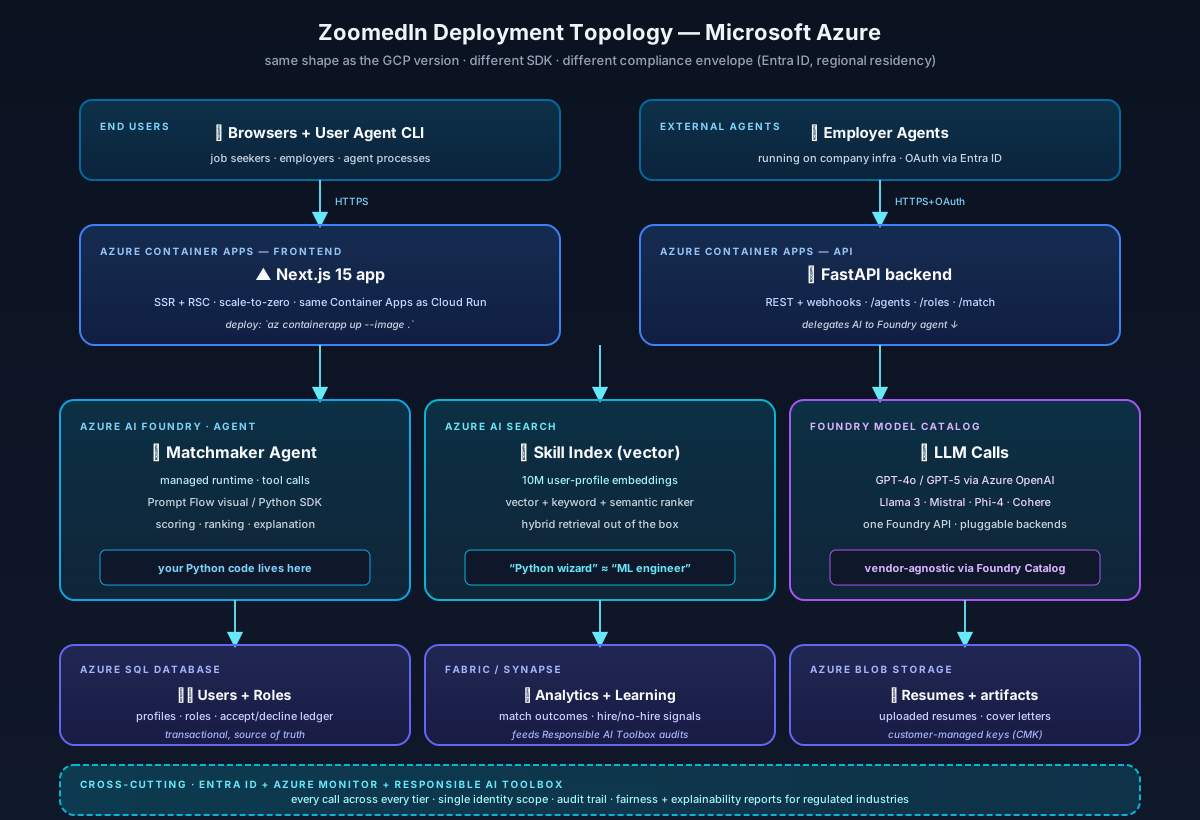
The Azure deployment topology — every box is a managed service, every arrow is an SDK call. From `git push` to production is mostly `az containerapp up` + `az ai project create` + a few deployment YAML files.
# Frontend (Next.js) - Azure Container Apps, scale-to-zero
az containerapp up --name zoomedin-web --resource-group rg-zd \
   --image $REGISTRY/zoomedin-web:latest --ingress external

# Backend (FastAPI) - same pattern
az containerapp up --name zoomedin-api --resource-group rg-zd \
   --image $REGISTRY/zoomedin-api:latest --ingress external

# Matchmaker agent - Azure AI Foundry
python -c "
from azure.ai.projects import AIProjectClient
from azure.identity import DefaultAzureCredential

# Current SDK (replaces older from_connection_string pattern):
project = AIProjectClient(
    endpoint='https://zoomedin.services.ai.azure.com/api/projects/zd',
    credential=DefaultAzureCredential(),
)
project.agents.create_agent(
    model='gpt-4o',                # or Llama via Catalog
    name='zoomedin-matchmaker',
    instructions=MATCHMAKER_PROMPT,
    tools=[skill_search_tool, scoring_tool],
)"

# AI Search index (one-time)
az search service create --name zoomedin-skills \
   --resource-group rg-zd --sku standard

# Done. Foundry endpoint is what your backend POSTs to.🎓 30-second mental model — Azure edition
Azure AI is a set of SDK calls inside the Microsoft enterprise envelope. Same idea as Vertex AI on GCP. You write Python that imports azure-ai-projects + openai + azure-search-documents. You authenticate via Entra ID (no API keys in code). You call embed(), search(), complete(), agents.create_agent(). The Microsoft difference: deeper integration with Entra ID + GitHub + M365, FedRAMP High in more regions, and Foundry's Responsible AI Toolbox as a first-class governance layer (fairness, explainability, content safety) that's harder to assemble cleanly on other clouds.
Ecosystem Flow
Hub-and-spoke topology centered on Azure AI Foundry. Developers reach Foundry directly or via GitHub Copilot; Foundry orchestrates model access via Azure OpenAI and governance via the Responsible AI Toolbox; every output flows through the compliance wrapper (Entra ID identity, Azure regional residency, M365 integration) before landing in Production.
The 4 Services — Plain English
The four pillars of Microsoft's enterprise AI stack. For each: what it IS, why you NEED it, and how you actually USE it. Hover any underlined term for a full definition.
Azure AI Foundry
The unified workbench for building AI apps on Azure — Microsoft's answer to Vertex AI.
Microsoft's unified developer surface. Foundry Hub (shared infrastructure across teams) + Project (specific app) structure. Includes a Model Catalog with frontier and edge options, Prompt Flow for visual agentic workflows, evaluation tools, content safety filters, and managed endpoint deployment. All inherits Entra ID identity and Azure compliance.
Without it, building enterprise AI means stitching together model APIs (OpenAI, Anthropic, Hugging Face), separate evaluation frameworks, ad-hoc deployment pipelines, and bolted-on compliance tooling. Foundry replaces that stitched stack with one managed platform with one identity and audit layer.
- Create a Hub + Project — inherits identity and compliance from your Azure tenant
- Pick a model from the catalog: Azure OpenAI for frontier, Phi for cost-sensitive, or your own fine-tune
- Build with Prompt Flow (visual) or code (Python SDK); evaluate against test sets; deploy to a managed endpoint
- Production app calls the endpoint via REST — Foundry handles auth, regional residency, and audit logging
Azure OpenAI Service
OpenAI's frontier models, on Microsoft infrastructure, under Microsoft compliance.
OpenAI's actual models (GPT-4o, GPT-5, o-series reasoning, Whisper, DALL-E, text-embedding-3) running on Azure infrastructure. Same model weights as OpenAI direct, different envelope: Azure billing, Entra ID auth, regional deployment (data stays in your chosen Azure region), Azure compliance posture (SOC 2, HIPAA, FedRAMP High, IRS 1075).
Direct OpenAI API is usually disallowed by enterprise security policies — no SSO with corporate identity, data leaves the compliance boundary, no regional control. Azure OpenAI satisfies the same controls Azure already satisfies, so enterprises consume OpenAI's models without weakening their security posture. This is THE answer for regulated industries.
- Deploy the desired model into your Azure region (model availability varies by region — check the deployment table)
- Configure access via Entra ID groups (no per-developer API keys to leak)
- Your app calls the regional endpoint with Azure AD tokens — same OpenAI Chat Completions / Embeddings API surface, different auth and audit
- All requests log to Azure Monitor with full compliance trail; prompt-shielding rules can block PII / harmful content at the edge
GitHub Copilot
AI-augmented development at organization scale — OpenAI models inside the IDE.
The IDE-resident coding assistant ecosystem: Copilot (inline completion), Copilot Chat (conversational), Copilot Workspace (issue → plan → PR), Copilot for Pull Requests (auto-review), Copilot Enterprise (org-wide policies and audit). All powered by OpenAI models behind the scenes — currently GPT-4o-class for completions and Chat, with newer models rolling in via Foundry.
Where Cursor wins on raw context depth and model-choice flexibility, Copilot wins on enterprise IT integration — SSO via Entra ID, audit logs, policy controls, GitHub-native review workflows that fit existing engineering processes. Enterprises already on GitHub Enterprise get Copilot rollout with one toggle, not a tool-procurement cycle.
- Enable Copilot Enterprise at the org level (inherits SSO from Entra ID)
- Developers use Copilot inside their IDE (VS Code, JetBrains, Visual Studio) — completions, chat, Workspace planning all available
- Admins set policies (which repos can use Copilot, what license terms apply, which models are allowed)
- Audit logs capture every Copilot interaction for compliance review
Responsible AI Toolbox
Governance, fairness, interpretability for AI in production — the audit evidence layer.
Microsoft's open-source toolkit for AI model governance — fairness assessment (disparity across protected groups), error analysis (which cohorts the model performs worst on), interpretability (which features drove a prediction, via SHAP/LIME), and what-if testing (changing a user's skills slightly to see whether their match score changes, confirming the model treats similar candidates similarly). Pairs with Foundry's built-in content safety / prompt shielding for end-to-end Responsible AI compliance.
Regulators are catching up to AI — EU AI Act, US executive orders, sector-specific rules (financial, healthcare, hiring). "Our model is fair" isn't enough; you need evidence of fairness with reproducible methodology, documented and exportable. The toolbox provides that evidence in a vendor-supported open-source package, which carries weight in audit conversations that homegrown analyses don't.
- After training a model, run Fairness Assessment to compute disparity metrics across protected groups (gender, age, race, geography)
- Run Error Analysis to find which user cohorts the model performs worst on — often where the bias lives
- Use Interpretability (SHAP / LIME) to explain individual predictions; use Counterfactuals to test "what minimal input change flips the output?"
- Export the resulting reports as part of your model governance audit trail — required documentation for regulated industries
Cross-References
- Model Committee → Routing Patterns — when to route to Azure OpenAI vs Vertex AI Gemini vs Claude vs direct OpenAI
- Enterprise RAG Anatomy — Azure OpenAI embeddings + Azure AI Search as a Foundry-native RAG stack
- Observability & Evals — Azure AI Foundry built-in evaluations vs Galileo / LangSmith / Phoenix